The Biomedicine Frontier

The oldest medical school in the western United States, the Stanford School of Medicine has a long tradition of producing transformative biomedical innovations. This legacy includes the first synthesis of biologically active DNA in 1967, which ushered in the study of genetics, and the world’s first successful heart-lung transplant in 1981. Other discoveries made here — in magnetic resonance imaging and gene splicing — catalyzed the biotech industry.
Together, the Stanford School of Medicine, Stanford Health Care, and Stanford Medicine Children’s Health comprise Stanford Medicine — a preeminent academic medical center focused on research, education, and patient care. Stanford Medicine’s three entities have a singular north star: Precision Health. This high-tech, high-touch approach seeks to not only treat disease but predict, prevent, and cure it, precisely.
The Li Ka Shing Center for Learning and Knowledge, located to the left, is one of several School of Medicine buildings and serves as the primary hub for educational and leadership activities. Stanford Health Care’s adult hospital and Lucile Packard Children’s Hospital Stanford are located nearby.
Training Biomedical Leaders
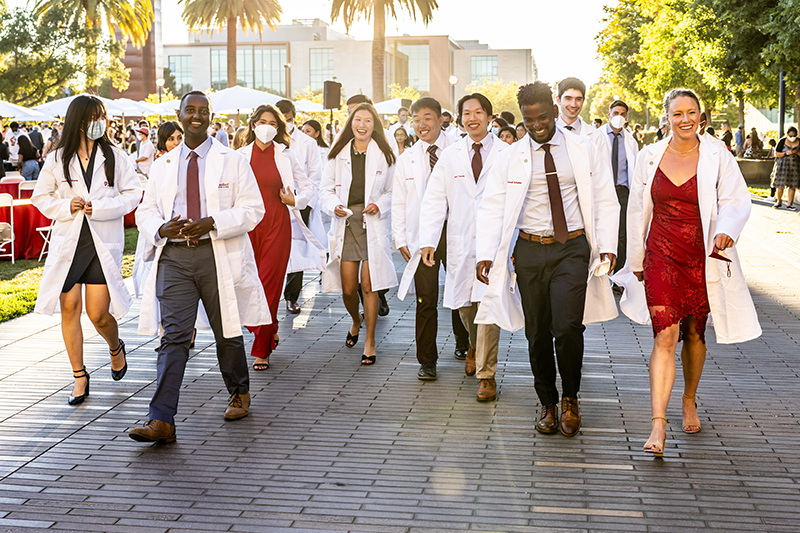
The Stanford School of Medicine’s rigorous multidisciplinary training is designed to produce the biomedical leaders of tomorrow. Our preeminent faculty, close relationship with Stanford’s six other schools, affiliation with clinical sites on campus and around the Bay Area, and ongoing associations with Silicon Valley uniquely position our students to redefine the future of health care for the benefit of all.

The Early Days
The university’s Founding Grant listed medicine as an important branch of the university. Stanford established its medical school in 1908, when it acquired Cooper Medical College in San Francisco. The medical school — as well as Stanford University Hospital — remained in San Francisco until moving to the Palo Alto campus in 1959.

Fighting Cancer
Cancer treatment has come a long way since a doctor and a physicist from Stanford developed a medical linear accelerator and used it successfully in 1956 to treat a tumor in a 2-year-old boy’s eye. Today, pioneering work with monoclonal antibodies, cancer vaccines, and immunotherapies improves countless patients’ lives, and cutting-edge basic science research promises to continue to establish the standard of cancer care.